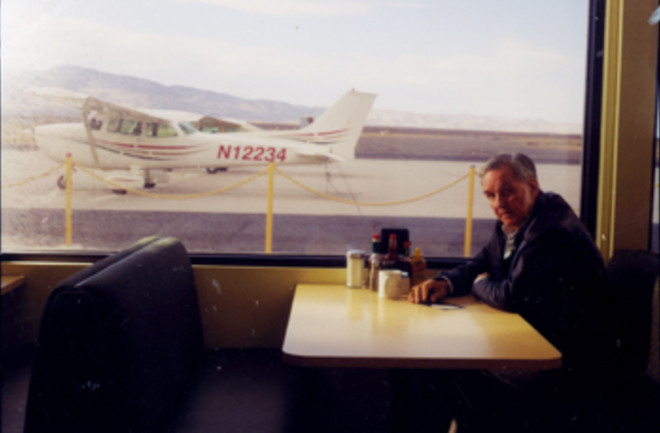
If Burt Rutan ever read science fiction, he might recognize himself. A strong-willed, technically skilled, maverick spaceship builder with a healthy disdain for bureaucracy and a libertarian streak a mile wide, the 64-year-old Rutan could have stepped from the pages of a Robert Heinlein novel. Rutan first came to fame in 1986 as the revolutionary designer of Voyager, the first airplane to circle the globe nonstop without refueling. No fewer than six Rutan-designed craft are in the Smithsonian’s aerospace collection, including his most famous design to date: SpaceShipOne. In 2004, SpaceShipOne was the first—and so far only—private manned spacecraft to fly above Earth’s atmosphere in a suborbital arc.
Rutan, with his company Scaled Composites, is now trying to capitalize on the success of SpaceShipOne by building SpaceShipTwo for Virgin Galactic, a space tourism company founded by another famous maverick, Richard Branson. Virgin Galactic plans to offer well-heeled tourists short suborbital trips into space by 2009. Ticket prices for the ride have been set at $200,000 per passenger, and to date, about 200 people have bought seats.
Looking a little like a futuristic corporate jet, SpaceShipTwo will be almost three times as large as SpaceShipOne, featuring a roomy passenger cabin with seating for six and a two-person cockpit. But the basic design is the same as SpaceShipOne—launched from an airplane, a hybrid solid/liquid–fueled engine will send the spacecraft arcing above the atmosphere. As the craft begins to fall back to Earth, hinged segments of its wings will rotate until they are perpendicular to the rest of the wings, automatically forcing the vehicle into the correct attitude during reentry.
DISCOVER spoke to Burt Rutan about his inspiration for SpaceShipOne, what SpaceShipTwo passengers can expect to get for their money, why the future of spaceflight doesn’t belong to NASA—and the aftermath of a recent explosion at one of Rutan’s test facilities during a test of rocket motor components that killed three people and severely injured three others.
SpaceShipOne is different from any other spacecraft ever flown. How did you come up with the design?
I was working at Edwards [Air Force Base in California] when [test pilot] Mike Adams was killed flying the X-15 there. He had instrument confusion and didn’t line the vehicle up straight during reentry, and it broke up. I focused on that because if we’re going to be flying members of the public, we need a generic solution to that sort of accident.
What is the future of NASA, given the rise of the private space travel industry?
NASA is using government money to try to do several things at once. It is trying to keep the shuttle flying, and every time it has an accident, it adds thousands more engineers and programmers who do more and more work. The more you fly, the more man-hours it takes to fly, rather than less. At the same time, NASA is trying to go out and develop something that can service the space station and also go to the moon and to Mars. This means we have a whole new generation of designers at NASA who are precluded from going out and looking for breakthroughs. They are forced into building a shuttle replacement using hardware from the ’60s and ’70s. They are using for the second-stage rocket engine essentially the same engine that was on the Saturn [upper stages], which is a very low-tech steel-cased engine. They do this because it would cost more to go out and invent something new, because to invent something new you have to try things that you don’t know will work. They worry that if things don’t work, Congress and the taxpayers may look at a failure as a waste of taxpayers’ money rather than a normal thing that happens when you are doing research. That’s why I don’t feel inappropriate in pronouncing NASA naysay, because they are forced to do that.
Sometimes it seems as if NASA doesn’t do anything right. Do you feel that way?
No, no. NASA does hundreds of wonderful things. They send robots all over the solar system. They have scientists doing all kinds of stuff. Some of it is good work. The stuff that JPL [the Jet Propulsion Laboratory in Pasadena, California] does is fabulous work.
People think I’m a NASA critic. That’s not true. I’m just saying what they are doing on [the manned space program] is not looking for the breakthroughs that are needed. The breakthroughs are likely to come from folks who go out and try some new stuff.
But I have a tremendous amount of respect for what JPL does. NASA did some phenomenal research during the 1960s in response to [Yuri] Gagarin [the first cosmonaut], and very quickly we were driving cars and playing golf on the moon. That is something that made me very proud to be an American who sent taxpayer funds to that NASA.
How will private spaceflight succeed as an industry?Not by making [private] spaceflight twice as safe as government spaceflight, or 10 times as safe, but 100 or 600 times as safe. By 1931, after a few years’ experience of flying scheduled airlines, those planes were operating at roughly 600 times the safety of the space shuttle. I look at safety not in terms of fatalities per passenger-mile, but when you get in and close the door, what is the risk of dying on this flight? In 1931, for commercial airlines the risk was 1 in 33,000. For manned spacecraft it has been about 1 in 70. I believe that to have an expanding business that won’t be hindered by people’s fear of flying you have to be as safe as the airliners.
Is there a role for the FAA in maintaining safety in space, as the administration now has for airplane travel?The current solution is to let people fly at their own risk. Show them the safety record for the spacecraft they are flying on and have them sign a waiver that says they know this is dangerous and that they are willing to take the risk. The FAA only gets involved when it comes to the people on the ground, the public who aren’t choosing to be passengers. The FAA is obliged to enforce rules of operation so that people don’t have something coming through their roof and killing them. I don’t believe that [the FAA’s involvement should be so limited]—the problem is that spacelines will be much more at risk from a lethal liability climate than if they did have FAA approval on their spacecraft safety.
How does SpaceShipTwo compare with Russia’s old Soyuz capsule, which has already carried five private passengers into space?
I couldn’t compare it to a Soyuz. It’s OK for a space tourist like Anousheh [Ansari, who visited the International Space Station in 2006] to go into orbit in a very small capsule with tiny windows and three people crammed in. Because there you can have a destination that’s big and spacious. Ultimately there will be some really cool stuff, like a resort hotel in orbit. However, for the industry we’re starting now, for suborbital flight, there is no destination, so the spacecraft you go up in has to be large and spacious. That’s why SpaceShipTwo is much bigger than SpaceShipOne: It needs to be because you want those six people to be floating around and enjoying themselves.
What will a trip in SpaceShipTwo be like for a passenger?
Well, my job is not going to be running a spaceline or selling tickets or flying. My job is to build a spaceship that is affordable and safe enough to fly the public. We are working very hard to optimize the experience, because if you don’t give people the best experience, they will go somewhere else for their spaceflight.
What do you mean by “optimize the experience” for the passenger?I don’t want to indicate everything that entails because we’d just as well let our competitors find out about it at the latest possible moment! But some of the things we have talked about are that the ships will be large with large windows. It will be a large cabin. The details on how that’s done we will be proving in test flights. I wouldn’t be surprised if at that time we discovered other features that would add to the experience.
Looking out the window, what would I see?We will likely be flying downrange a couple of hundred miles instead of going straight up and down like we did with SpaceShipOne. So the view will depend on where you fly. The photographs of space taken by our astronauts have been published all over the place. But the eye is a much more dynamic mechanism than any camera or pictures. It’s a more exciting view in person than looking at the photographs. Of course, I personally am sick and tired of hearing people talk like that: I want to see it myself!
How will passengers prepare for flight?We will use the launcher [the airplane used to carry SpaceShipTwo to high altitude] to simulate the reentry. By doing a descending return [with SpaceShipTwo still attached to the launcher], we can actually expose the passengers to high reentry g-loads and also give them a real experience of what this gentle and slow buildup of g’s during reentry is like.
I think during your day or two of training, you will likely go up in the launch airplane and do some floating around in the cabin. You’ll do it in the same seats and windows in the cabin that you’ll go up in. I think you’ll be able to just show up at the spaceport and training facility two or three days before your flight.
Will passengers on SpaceShipTwo be able to take pictures?
I don’t think you’ll want to. I think there will likely be video cameras mounted in the cabin taking pictures of you. I say you won’t want to take pictures because when you go to the Grand Canyon, you walk out to the guardrail and look out there. You usually don’t approach with your camera in the on position and walk up and take a picture. You usually see people enjoying it with the best lenses we have, which are our eyes. Then before leaving, you take some pictures so you can show your friends at home.
The problem with a suborbital spaceflight experience is that it is relatively short. You would certainly be taking snapshots if you were spending a couple of weeks in a resort hotel on orbit. But for suborbital flight I think it will be better if the pictures you see are pictures of you watching, documenting your experience. It’s something that will be automatically done, rather than you fumbling with your camera.
What do you say to those who argue that what you’re doing is not really contributing to space exploration, it’s just providing expensive entertainment for the rich?Look at personal computers or how the Internet grew: Something done for fun turned out to be as necessary as electricity and water. It’s because creative people saw what was there and discovered a better use for it. I think we will find that if we reach our goal of flying 100,000 people in the first 10 or 12 years on SpaceShipTwo, along with others out there with their different spaceships, you are going to get some unforeseen creativity, someone who will figure out something as important as the Internet.
What are the most difficult technological bugs facing you in the development of SpaceShipTwo?
If I told you that, it would be very revealing to my competition! I would love it if Jeff Bezos [the founder of Amazon.com and Blue Origin, a rival spaceflight company] came out and told me the two most difficult things about developing his suborbital ship.
Do you have any advice for someone coming out of college who wants to design spacecraft?I would say that you don’t have to be stuck working for NASA anymore, and that is good news. When I got out of college, America built and flew into space five different launch systems in seven years. We’re now talking 13 years to do one launch vehicle, and it’s going to be based on hardware that is 30 and 40 years old. So my advice would be, let’s just hope that there will be a bunch of companies like mine developing new rocket launchers, spaceships, and boosters, like we did in the ’60s. I personally think there will be a lot of jobs.
Is there a private space race going on?Of course there is; the biggest competitors are the Russians. Just like in 1961 with Gagarin, the Russians have beat us on the first salvo with Dennis Tito [the world’s first space tourist]. Who would have thought in the 1960s that the first capitalists to sell tickets to let the public fly would be the damned Russians? Who would have thought that? Doesn’t that piss you off? Well, we’re going to do something about that.
Who are your competitors?Virgin Galactic, which will be operating SpaceShipTwo, will be only one of several spacelines. The competitors for Virgin include the Russians, Bezos’s Blue Origin, and possibly Rocketplane Kistler. And likely a couple of others who are smart enough not to tell people what they are doing!
What will spaceflight look like a century from now?A century is a relatively short period of time. Let me stick my neck out a little bit further and say that in 300 or 400 years, a large majority of people will go to a planet and not return back to the Earth. We will colonize. Lewis and Clark went out and back. But most of the people who followed them went to California and stayed there. In a hundred years, I believe you will see such an enormous reduction in the costs of transportation around our solar system that there will be a lot of travel. I’d like to see affordable transportation into space in my lifetime.